

Robot Service TCP Notes: Receive Chunks and Message Boundaries
2026-11-05
Robot Service TCP Notes: Receive Chunks and Message Boundaries
Receive Chunks in a robot service TCP log are not automatically complete protocol messages. One receive operation handles bytes from network buffers, while an application protocol defines what constitutes a message. A log that labels each returned chunk as one robot response can therefore hide an interpretation problem. This article reads public documentation to explain existing service material. It opens no connection, sends no command and runs no client code.
Identify which interface the attachment describes
Robot controllers can expose several communication interfaces with different data formats. A service appendix should retain the actual interface name, software context and contributor's account of how the text was logged. A familiar TCP label does not identify the application protocol, and a line displayed by a logging tool may reflect that tool's presentation choices.
Keep an original byte-oriented record separate from a later human-readable summary when the contributor supplies both. The summary should explain whether its entries represent raw reads, reconstructed messages or an author's description of events, because each label implies a different processing step. This article has received neither and reconstructs no real communication. Its question is whether the explanation preserves the difference between transport reads and the protocol units a service engineer intends to discuss.
Read a receive operation at its buffer scope
The official Python Socket Programming HOWTO explains that send and recv operate on network buffers and do not necessarily handle all the bytes associated with a complete message in one call. A receiving account should therefore avoid treating the call boundary itself as proof of a message boundary.
A short result can contain only part of an application message. The HOWTO also explains that a read can include the beginning of a following message when several are sent back to back. Those possibilities explain why counting read calls and counting protocol messages are separate tasks. They are not observations that either case occurred in a particular robot's log.
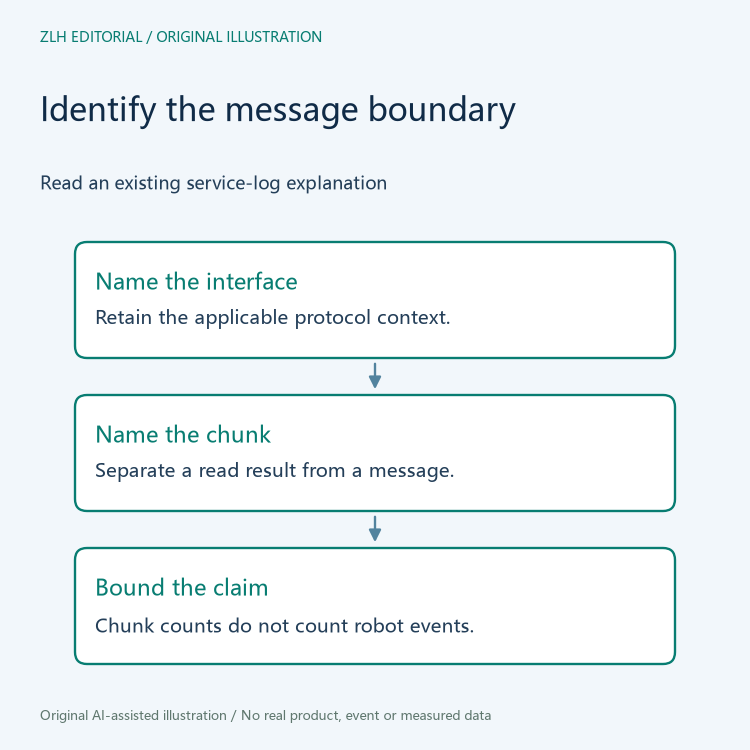
Retain the application's own framing rule
The HOWTO describes several ways applications define message boundaries, including lengths and delimiters. These are protocol choices. A recipient should ask which documented rule applies to the submitted material rather than assign boundaries wherever the client happened to return control to its caller.
The official UR e-Series Dashboard Server article provides a concrete robot-interface example: it requires commands to terminate with a newline. That is a command-format requirement in the identified interface. It does not turn every TCP receive chunk into a complete command, and this article does not invent a response grammar from that one requirement.
Separate displayed lines from retained bytes
A contributor may have a logger that accumulates bytes, splits them into lines or adds its own timestamps before display. Those transformations should be explained if the appendix relies on the displayed line count. The recipient needs the actual logging account, rather than an assumption that the screen reproduces every low-level receive result unchanged.
Likewise, a fragment shown without its surrounding data should not immediately be called a malformed robot message. It may be incomplete as an attachment or reflect a read boundary. This article identifies a question about the evidence; it does not diagnose a controller, network or client implementation that has not been examined.
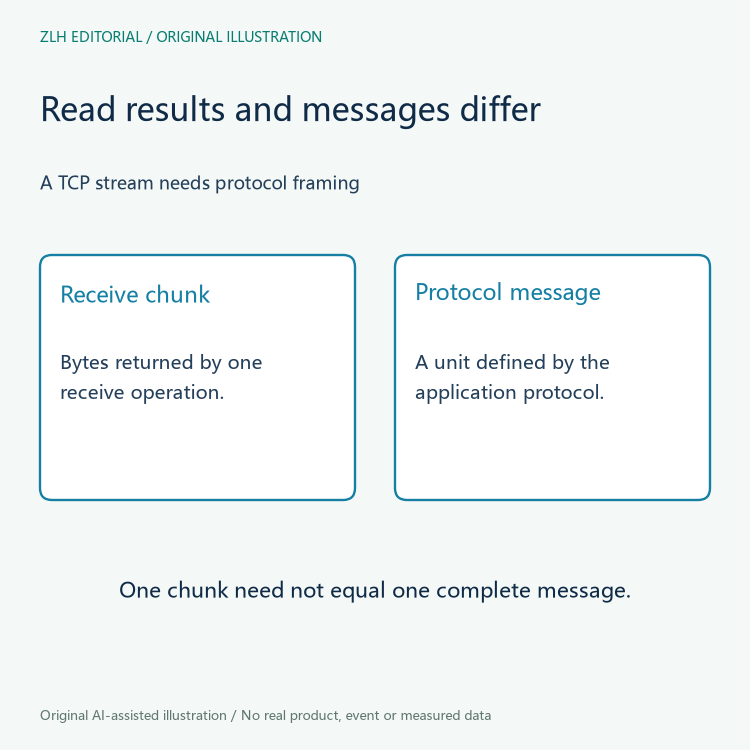
Review a fictional service summary
Imagine a fictional service summary reporting several receive calls and declaring the same number of robot events. It provides no protocol parsing account. The reviewer should ask how the contributor associated the chunks with messages and how those messages were associated with events. This invented example has no actual byte sequence, command or incident.
A focused correction can retain the observed read-call count under its original label, while leaving message and event counts unresolved. It should not merge fragments merely to create a plausible response or invent missing text. Any later reconstruction would need the original material and an explanation of the procedure actually used.
Keep the service conclusion within the supplied record
The Python source was read in its 3.14.10 documentation context, and the UR article retains its e-Series scope and version caveat. Both were read on November 5, 2026. Their operating examples were not executed or adapted into a device-access procedure. No connection parameters or command sequence are supplied here.
The original figures contain no real network capture or controller response. Related material appears in the robot service-software collection and article directory. Keeping Receive Chunks distinct from protocol messages lets a service note describe its actual evidence before making claims about what a robot communicated or why an incident occurred.


