

Robot Service Parameters: Read-Only and Dynamic Types
2026-11-05
Robot Service Parameters: Read-Only and Dynamic Types
Service parameters in a robot support appendix can have restrictions on changing a value and a separate statement about changing its type. A report that reduces both ideas to editable may lose the distinction needed to understand the supplied descriptor. This article reads the ROS 2 Jazzy ParameterDescriptor definition through a hypothetical service packet. It reads no live node, changes no parameter and makes no finding about the cause of a robot problem.
What restriction does read_only describe?
The official Jazzy ParameterDescriptor page says that when read_only is true, the value cannot change after initialization. The initialization boundary belongs to that description. It should not be shortened into an unexplained claim that a field is absent, inaccessible to a reader or physically fixed in the robot. Those statements would concern different properties.
Suppose a hypothetical support table labels one parameter locked. Ask whether that label represents the descriptor's value-change restriction or some other application condition. The source field name and the contributor's explanation should remain visible. Without that relationship, two readers could agree about the word locked while understanding different restrictions. This article has inspected no actual support table and asserts no configuration finding.
What permission does dynamic_typing describe?
The matching Jazzy source definition says that dynamic_typing permits the parameter to change type when true. That is a statement about the type, rather than a replacement definition for whether a value can change. Both fields appear separately in the descriptor. Their separate presence is a reason to preserve separate columns in an explanatory support summary.
A hypothetical appendix might call a parameter fixed type and then conclude its value cannot change. That conclusion does not follow merely from keeping the same type. A value can be described as belonging to a type without the type description alone answering every mutability question. The reviewer should request the actual descriptor and applicable application account, rather than infer a value-change restriction from a shortened type label.
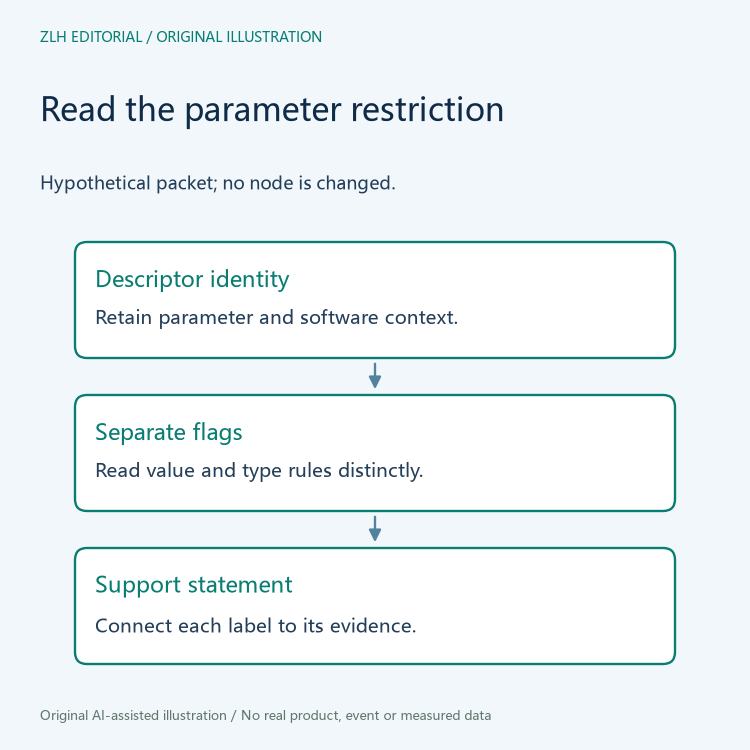
Does a descriptor replace the application's explanation?
The definition communicates a parameter descriptor with a name, type, description and constraint information. A service record should identify which parameter and node the contributor says it describes. A detached descriptor excerpt cannot identify every application that uses a similarly named parameter. The message definition explains a representation; it does not establish the identity or current state of an unknown running program.
Keep any actual setting attempt or reported response as separate evidence. A descriptor screenshot and an application response answer related questions, but neither should silently replace the other. If a contributor reports that a change failed, ask which operation and response the report concerns. This article supplies no commands, recommends no parameter values and does not treat a failed change as a diagnosis of mechanical or electrical condition.
Other constraints also remain part of the descriptor account. The definition has additional_constraints and optional numerical range representations. Reading the two flags does not erase those fields or guarantee that every application request would be accepted. A reviewer can identify the missing constraint material without inventing a permitted range or testing an unknown node. The actual project owner must explain the applicable configuration context.
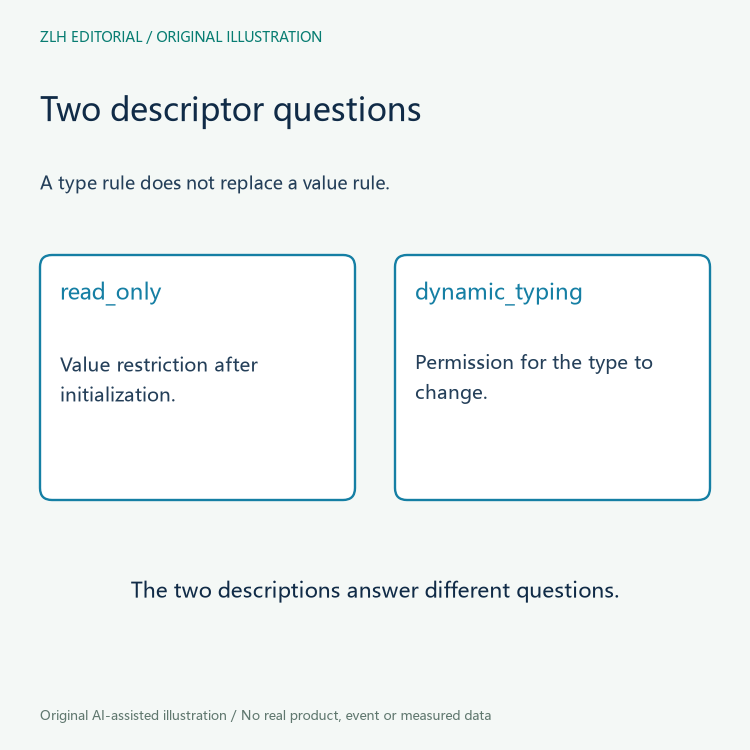
How can a support summary preserve both questions?
A useful summary names the source descriptor and keeps value-change restriction and type-change permission distinct. It also identifies the software distribution and the supplied observation date or record context. This makes the clarification concrete: which field supports each label in the summary? A row marked unknown should remain unresolved until the contributor supplies the missing evidence.
If the contributor corrects a heading from fixed value to fixed type, preserve that correction's relationship to the earlier summary. A terminology correction need not mean the program itself changed. Conversely, a changed descriptor should not be presented as merely a new caption if the underlying record differs. Keeping both versions traceable lets a later service reviewer understand the scope of the update.
The cited page and source branch both belong to Jazzy. Another distribution or a custom interface needs its own documentation rather than an assumption that the same field labels settle every detail. Neither a correct descriptor nor a readable screenshot certifies the robot's condition. The material here remains about interpreting a software appendix for a robot service discussion.
Both original figures are conceptual documentation aids without live values or operating instructions. Further material appears in the robot service-material category and related resource category. Keeping service parameters attached to their separate value and type rules helps the responsible contributor answer a precise question about the supplied record.


