

Robot Maintenance FAQ: Read the Deprecated Safety Field
2026-11-05
Robot Maintenance FAQ: Read the Deprecated Safety Field
A Robot Maintenance FAQ may begin with a small but consequential question: does an old field name still mean what the current reference describes? A service appendix can preserve useful historical information while using terminology that a newer guide has deprecated. That calls for a careful reading of the source and its version, rather than an automatic replacement. This article examines the Universal Robots RTDE documentation as document evidence. It does not read a real controller, interpret an active stop or prescribe a recovery action.
What exactly is deprecated in the current field table?
The current RTDE guide lists safety_mode as deprecated and directs readers to safety_status. Both appear in the output-field table, with safety_status identified as an integer field and accompanied by an introduction-version entry. The deprecation belongs to that field description. It is not a finding that every historical service attachment using the older name is false.
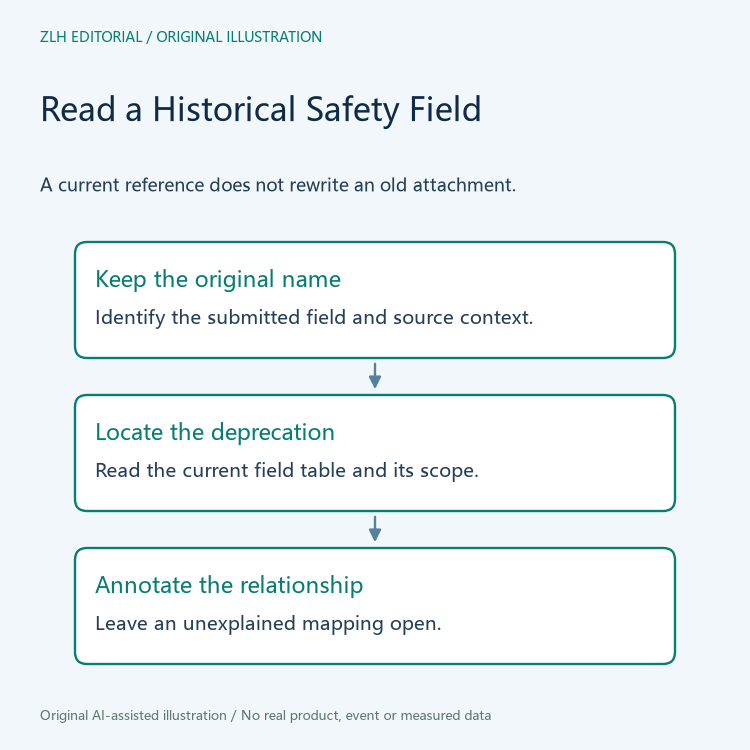
The first editorial question is therefore which source the attachment used. Retain the submitted field spelling, the contributor's controller-software context and the cited reference. If the appendix simply says “safety state,” ask for the original field name before interpreting it. Similar display labels can conceal different source fields, and an editor should not reconstruct that missing identity by choosing the newest familiar term.
Why does the constants section need its own scope?
The inspected guide explicitly scopes its Safety Status constants section to software versions 10.12.0, 5.25.0 and later. It also reserves unlisted values for internal use. Those boundaries matter when reviewing an older attachment. A current table should not be silently applied to an unspecified historical export, especially when the contributor has not explained which documentation governed its interpretation.
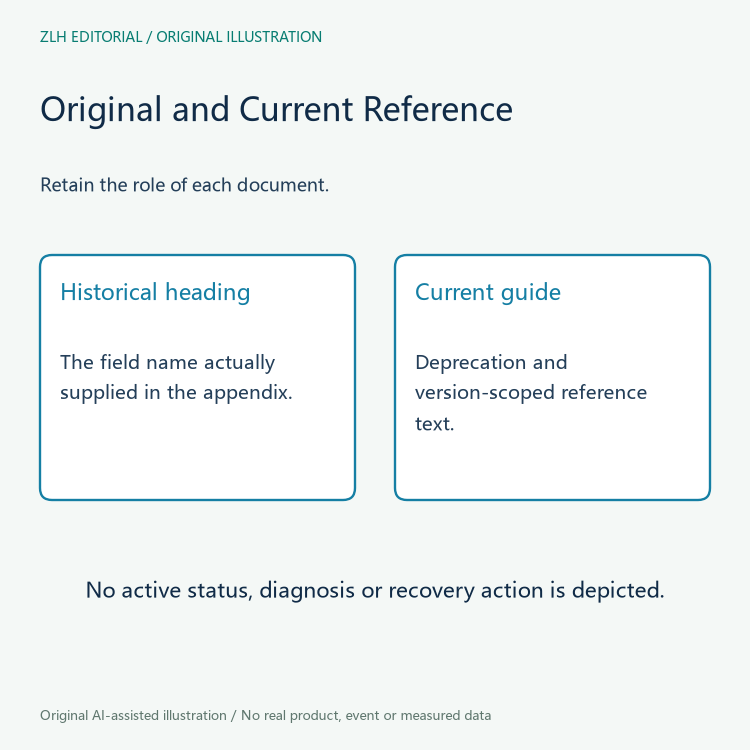
A sensible service note can separate the original attachment from an editorial cross-reference to the current guide. The original retains what was supplied. The cross-reference states what the inspected current documentation says. If the relationship between them is unresolved, say so. That is more precise than either deleting the old name or claiming that a newer name automatically validates the old values.
What does the client-library reference explain about labels?
The official RTDE Python-client documentation describes recipes containing named fields and types, and data objects whose members follow the configured variable names. This provides a useful explanation of why the actual field name belongs in the service appendix. A broad prose caption does not preserve the same identity as the contributor's declared output field.
The client page describes a historical Python development context, so it should not be presented as a newly tested client environment. Here it supports only the documentation relationship among configured field names, data objects and exported headings. No client is installed or executed. The reader can ask which recipe or export account produced the attachment without requesting a connection to the service machine.
How should a fictional historical appendix be annotated?
Imagine a fictional case called Service Alder. Its attachment has a column named safety_mode, while a new summary relabels the column safety_status without an explanation. The editor has no evidence of a conversion or a revised export. The documentation finding is the unexplained relabeling. It is not a diagnosis of the robot represented by the fictional case.
A useful revision would keep the original heading and add a note about the current guide's deprecation. Ask the responsible contributor whether the historical field was retained intentionally and what source explains its values. If the contributor supplies a replacement attachment, identify it as a new attachment with its own context. Do not present a manually edited heading as if the controller generated a different field all along.
The same discipline applies to a screenshot. A visible word in an interface is an observation about that submitted view. Without the source account, it does not establish which underlying field was recorded. Preserve the screenshot's caption and ask the contributor to describe the relationship. Documentation can remain useful while that mapping is pending, provided the missing relationship is stated plainly.
What can the maintenance review actually conclude?
The review can establish that the appendix retains its original field name, identifies its source context and clearly distinguishes a current-reference annotation from historical content. It can list any unanswered mapping or version question. It cannot establish the cause of a stop, the condition of hardware or permission to resume work. None of those conclusions follows from correcting a field label.
The site's maintenance-reference category and related-information category offer further navigation. When a later case revision changes terminology, review the supporting explanation again. Keeping the historical record and current reference understandable helps the next reader follow the evidence without converting an editorial update into an unobserved technical result.


