

Robot Service Logs: Structured Body and Displayed Text
2026-11-04
Robot Service Logs: Structured Body and Displayed Text
Robot Service Logs may be handed over as a screenshot, a text export or a description of a structured record. These materials do not necessarily preserve the same information. A screen message can be useful to read, but its appearance alone does not explain the original body's value type or how the display was produced. This article reads the OpenTelemetry logs data model and its common protocol definitions. It reviews a fictional software-service appendix without accessing a real log, decoding an export or diagnosing hardware.
Read the body's declared value scope
The official logs data-model Body description allows more than a plain message string. It discusses human-readable text and structured data, including arrays and maps, and requires support for AnyValue to preserve structured-log semantics. A service appendix should retain that scope rather than define every log body as one flat text sentence.
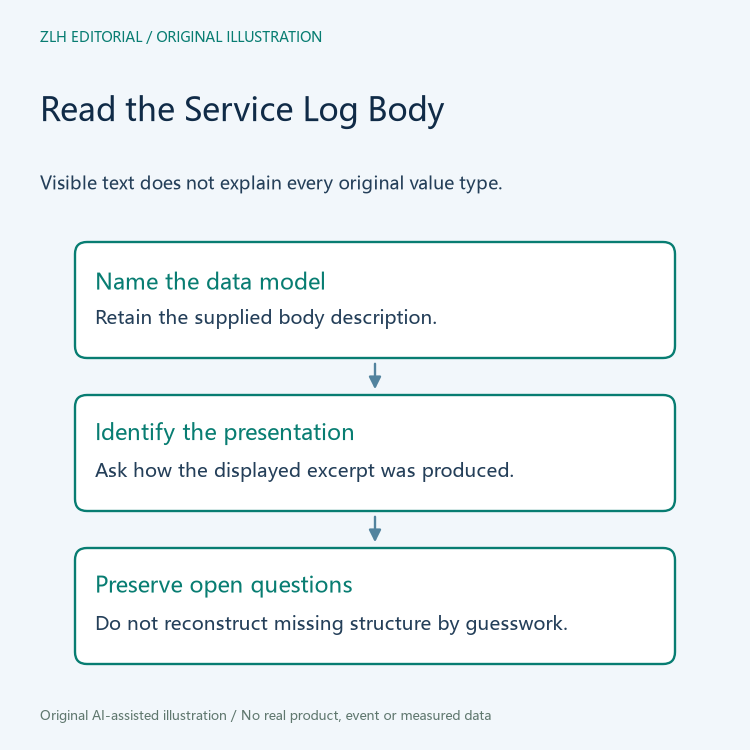
For a proposed intake record, identify the declared data model and the contributor's description of the supplied body. If the packet contains only a screenshot, state that evidence boundary. The reviewer should not infer the original value structure from punctuation that happens to appear on screen. A display could use formatting conventions that are not explained in the submitted material.
Keep a value structure separate from its visible presentation
The official common protocol definition describes AnyValue as supporting primitive values as well as nested arrays and key-value lists. These declarations provide source vocabulary for a structured-body discussion. They are not evidence that a particular screenshot was generated from any one of those alternatives.
If the contributor claims that a displayed line represents a structured body, ask how the presentation relates to the supplied value. Retain the declared representation and the source account of the formatting. Do not invent a parsing rule or reconstruct missing nested fields from a screen image. The task is to understand the account supplied, rather than to create a new record and present it as the original.
Ask what the export or screenshot is intended to preserve
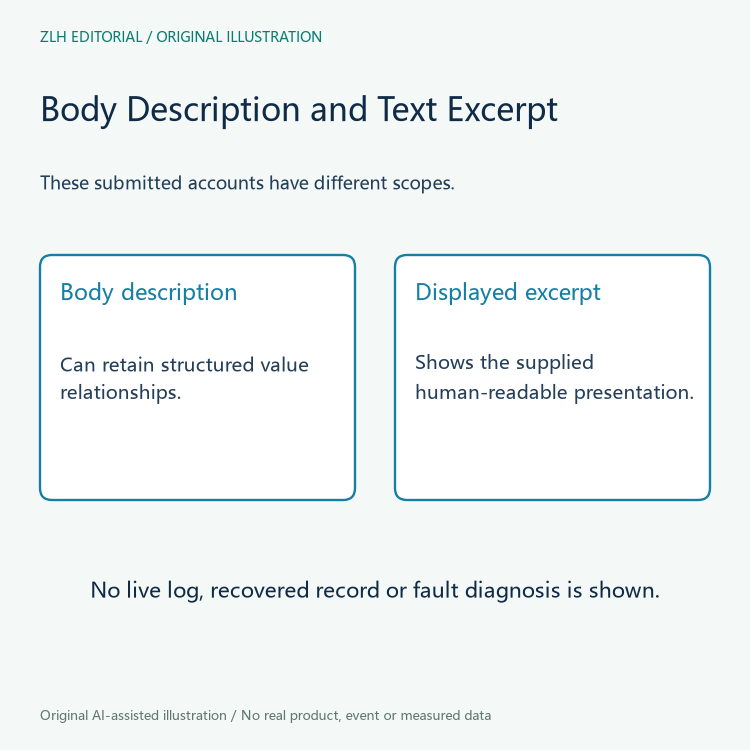
A readable display and an exchangeable structured record serve different purposes. The first can communicate a message to a person, while the second can retain data relationships for later interpretation. A handover should explain which purpose the submitted attachment addresses. Neither purpose should be assumed from a broad label such as “complete log.”
For example, if an export is intended to preserve nested values, ask the contributor to identify that claim and its evidence. If the attachment is only an illustrative screenshot, label it as such. A screenshot can still be useful without being treated as a lossless representation of every original field. The record becomes more honest when it identifies what the supplied material does and does not explain.
Review a fictional flattened service appendix
Imagine a fictional appendix for Robot Willow Console. Its source note describes a structured body, while a local document copies only the visible message text and labels that copy “the full record.” No export account or formatting explanation accompanies the statement. The reviewer can identify that the label overstates what has been supplied without reading an actual device log.
A useful correction would retain the visible text as a display excerpt and separately identify the contributor's structured-body description. If the contributor supplies an export later, preserve it as additional evidence with its own declared format and relation to the excerpt. Do not silently promote the existing screenshot into proof that all structure was preserved. A new attachment and a clarified caption are different changes.
When reviewing the revision, ask whether the original question is now answered. If the contributor explains only the display layout, the body's original structure may remain unresolved. If the contributor explains the structure but not the excerpt's origin, that is another open relationship. Keeping the questions separate avoids closing the entire service record with one general checkbox when only one part has become clear.
Keep the conclusion about record meaning, not fault cause
A bounded review conclusion can say that the appendix now distinguishes a body-value description from the displayed-text excerpt and identifies their stated relationship. It can list any remaining question about the export or presentation. It should not state that the log has been fully recovered, that the data is authentic or that a robot fault has been diagnosed.
The site's reference category and related-information category offer further navigation. When a later tool or export format changes the presentation, revisit the explanation rather than assuming that similar-looking text represents the same retained structure. A readable message is valuable, and its original data context deserves its own account.


