

Maintenance Log Practice: Identify the Warning Route
2026-11-03
Maintenance Log Practice: Identify the Warning Route
A maintenance application can display a software warning in one environment while another record appears quiet. Before interpreting the difference as a change in robot condition, identify how warning messages are handled. Python's warnings mechanism and its logging system have related but distinct roles. This exercise documents the warning route of an identified application without injecting warnings into a live service or changing its configuration.
Identify the application and the missing observation
Record which process, environment and period belong to the case. Ask whether the reported difference concerns a console message, a log file, an exported view or another output. These surfaces can contain different material. A statement that no warning was visible should identify where the observer looked and what evidence is available.
Retain the original record and the application's configuration documentation. If the process has restarted or its settings have changed since the event, preserve that chronology. Current settings can help explain a design, but they do not automatically establish how an earlier process handled the warning in question.
Read the warning policy separately from logging
The Python warnings documentation explains warning categories, filters and the warning display process. Those rules can affect whether and how a warning is presented. Record the applicable policy as described by the application owner instead of assuming every issued warning must appear in every output.
Do not treat a warning category as a diagnosis of physical equipment. A software message can concern an API, configuration or other program condition. Keep its exact text, category and available location information with the case, and let the responsible specialist explain its relevance to the reported activity.

Check whether warning capture is part of the route
The logging captureWarnings documentation describes directing warnings into logging through the py.warnings logger at WARNING level when capture is enabled. This is a specific routing feature. Its existence in Python does not establish that a particular maintenance application enabled it.
Ask the application owner where that choice is made and which process it applies to. Retain the explanation beside the warning-policy record. If the application uses another documented route, describe that route rather than forcing the observation into the captureWarnings model. Do not change the running process just to make its output resemble another case.
Follow the record to the output actually reviewed
Once the route is understood, identify which retained output could contain the warning. A captured warning still needs a documented path to the view or file being examined. A filtered export may not include every category, and a console capture may differ from an application log. Preserve the scope of the actual material.
Compare observations using the same identified process and period where possible. If those conditions differ, state the difference before drawing a conclusion. A quieter screen does not independently prove that fewer software conditions occurred, and the presence of a warning does not prove that a maintenance action failed.
Where the original output is unavailable, retain the gap explicitly. Do not reconstruct a message from memory and present it as captured text. A user's account of what they saw can be useful, but it should be attributed as a statement and kept separate from a retained application record.
Hand over a route description and a bounded conclusion
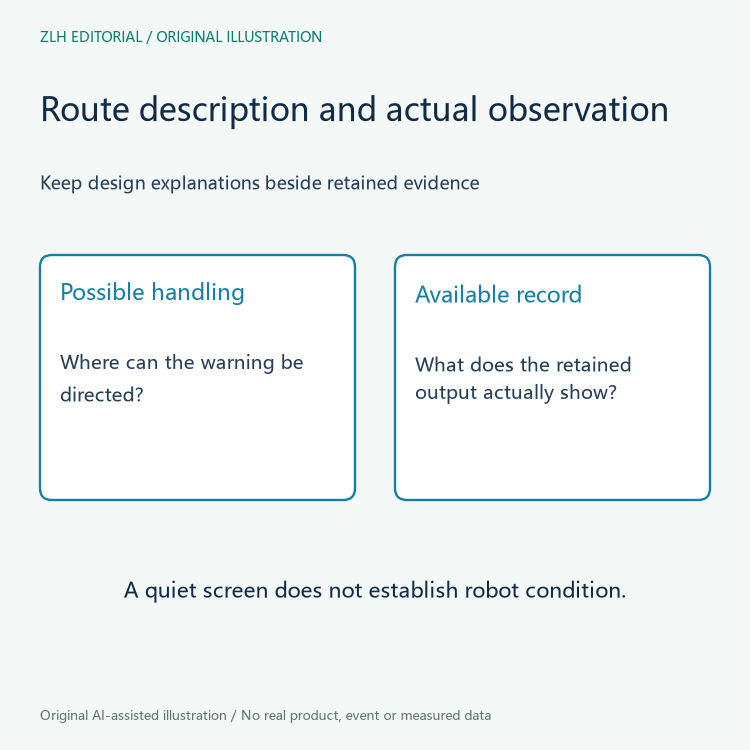
The note should identify the application, warning policy, capture choice, available output and unresolved historical questions. A route description explains where a message could be handled; an actual observation explains what the retained material shows. Keep those two forms of evidence separate in the case summary.
If a controlled diagnostic exercise is later authorized, define its environment and expected observation beforehand. Record any injected demonstration warning as a test event, not as a recurrence of the original condition. This article has performed no such exercise and reports no maintenance application output.
When several retained messages have identical wording, do not group them into a single occurrence without an event-identification rule. Conversely, repeated appearances of one message across a console and an export do not independently establish separate conditions. Preserve the available process, time and record identifiers, then ask the owner what relationship can be supported. The warning route can explain how one source contributes to several outputs, but it cannot supply missing identifiers retrospectively. Mark ambiguous associations as unresolved rather than creating a precise count from text similarity alone.
The original illustrations show the routing questions without customer records or fabricated warnings. Continue with the maintenance case record collection and article directory. Following the warning route makes differences between outputs easier to investigate while preserving the separate work of explaining the software condition and the actual maintenance case.


