

Python Sentinel News: Explain an Unavailable Case Value
2026-11-03
Python Sentinel News: Explain an Unavailable Case Value
Maintenance records sometimes need to distinguish a value that was not provided from a value whose ordinary meaning is intentionally empty. Python 3.15's sentinel feature offers a precise programming example of this distinction. For a service-case reader, however, the existence of a placeholder does not explain the operational meaning assigned to it by an application. That meaning still belongs to the case system's own documentation.
What the October language release introduces
The Python 3.15.0 release page, dated October 9, 2026, lists the new sentinel built-in. The release page now points to a later maintenance version, so this article concerns the feature introduced in the series. It does not recommend installing the original release or report a change to any particular maintenance portal.
PEP 661 explains the motivation for unique placeholder values, including cases where None is already a valid value and a distinct sentinel is needed. This is a programming design reference. It does not define how a service provider labels a case, why a field is unavailable or which information a technician actually supplied.
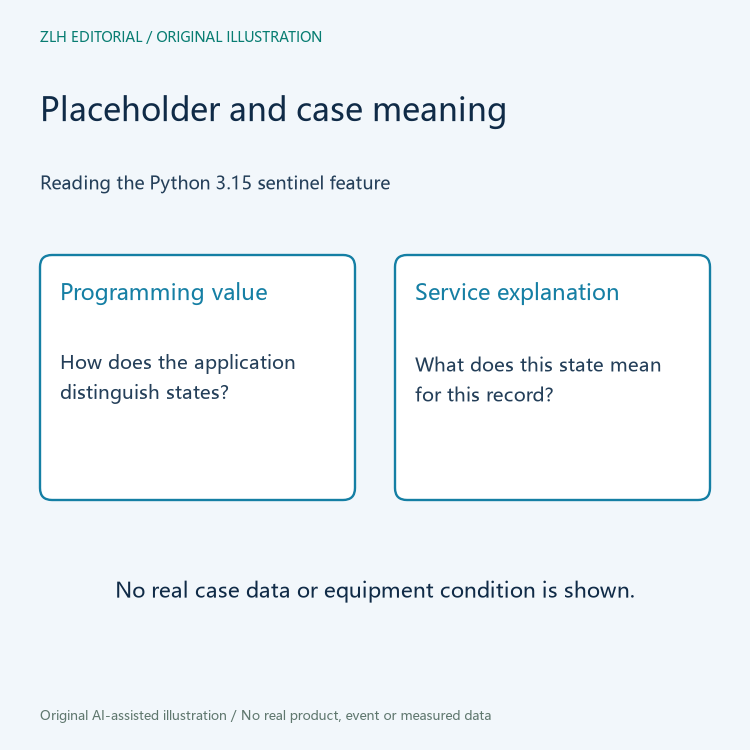
A placeholder needs an application explanation
Consider a hypothetical maintenance summary with an entry that the interface presents as unavailable. A reader should be able to ask what that state means in this system. Was the information not requested, not yet supplied or unavailable to the current view? These are possible questions for the provider, not conditions established by this article. The system's actual definition should supply the answer.
A developer may use a special value internally to keep such conditions distinct. The external record still needs language that a service reader can understand. An implementation name alone is not a sufficient explanation of an unfinished case. Likewise, a friendly label should not imply that the underlying state has been verified if the provider has not supplied evidence for it.
The documentation can identify who is responsible for explaining the field and where a reader can find the applicable definition. This makes it easier to handle ambiguity without guessing from a blank screen. The example contains no actual service ticket or robot condition, and the publication has not inspected a maintenance application's data model.
Distinguish a new answer from a changed display
If the hypothetical case later shows a value, the record should explain whether someone supplied new information or the interface merely changed how existing information appears. Those developments have different meanings for a reader following the case. A display update should not silently become evidence that a technician performed another action or reached a new conclusion.
A clear case history can retain the earlier state and identify the later contribution. If a correction changes the interpretation of an old entry, note the author and reason. Avoid rewriting the earlier uncertainty as if the answer had always been known. The goal is to preserve the relationship between information received and the case description visible to the reader.

Keep application rules beside actual case evidence
A rule describing what a placeholder means can guide interpretation, but an actual case statement still needs to identify its subject. The provider should explain which record the rule is being applied to and what evidence supports the resulting description. An editor cannot infer those particulars from the Python feature or from a generic screenshot of a portal.
The distinction also prevents technical cleanup from being reported as maintenance progress. Changing how a program represents an absent value may improve its implementation without adding any new information about equipment. If both software work and case work occur, describe each separately. No program, case state or equipment setting was changed for this article.
The explanation should remain available when a case summary is exported. A field label that is understandable inside the original interface may lose its surrounding guidance in another document. The export author can retain a reference to the applicable definition, making the absence meaningful to recipients who never saw the original screen.
Use the feature to ask a more precise records question
The sentinel development is useful background for understanding why applications may distinguish several kinds of unavailable value. The relevant maintenance question remains specific: what does the present state mean here, and who can explain it? A responsible answer should come from the application's definitions and the actual case record, rather than an assumption based on a programming term.
Our original illustrations show information roles without real case data or software output. Additional discussion appears in the maintenance case records collection and article directory. Preserving the meaning of an unavailable entry lets readers understand both what the record currently says and what still needs to be supplied, without inventing an equipment observation.


