

Maintenance Log Practice: Logger and Handler Thresholds
2026-11-02
Maintenance Log Practice: Logger and Handler Thresholds
Handler thresholds and logger thresholds answer related but separate questions in a Python maintenance tool. One concerns whether a logging call produces a record in the relevant arrangement; another concerns whether a handler dispatches a record toward its destination. This article proposes a reading exercise using a prepared configuration description. It does not inspect a real maintenance application, change logging settings, or infer a machine fault from missing output.
Draw the arrangement before explaining the missing message
Begin with an instructor-supplied description of one logger and its intended destination. Identify which component the application calls and which handler is supposed to send records onward. Naming the destination first can hide the stages that precede it. The exercise should make those stages visible before discussing an absent line.
The Python logging reference distinguishes loggers, handlers, filters, and formatters. Use those roles to read the prepared arrangement. A formatter’s presentation responsibility is different from a handler’s destination responsibility, and neither should be mistaken for the application event itself.
The fictional material contains no real records or settings. A learner can explain the route conceptually without adding a fabricated console transcript. Keep the original prepared description so a colleague can see which arrangement the explanation concerns.
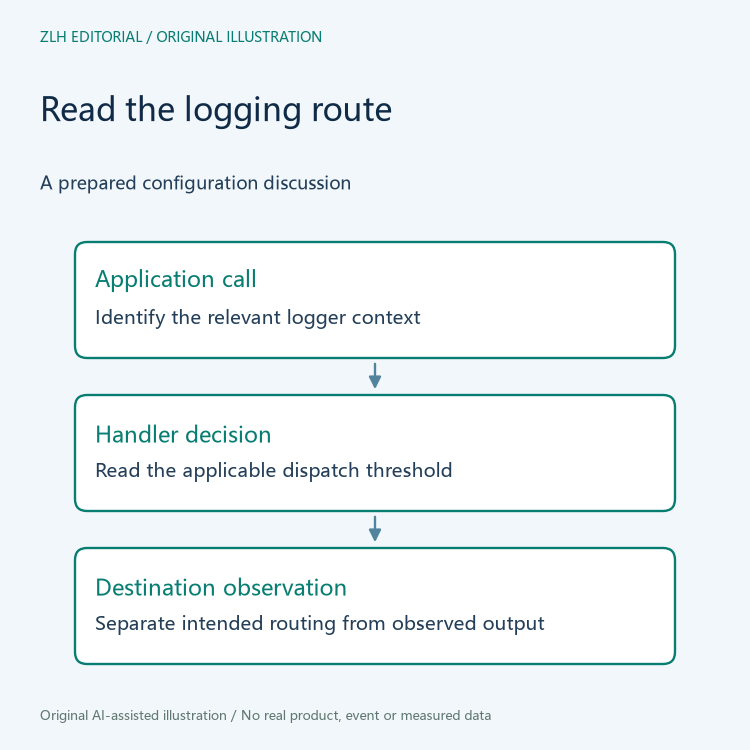
Ask what the logger stage permits
The official logging HOWTO explains the level-based decision at the logger stage. A learner should relate the call’s level to the relevant logger configuration rather than assume that every call necessarily becomes a visible message.
For the exercise, ask the instructor to identify the effective level in the prepared arrangement. Avoid guessing it from a logger’s name. If hierarchy or inherited configuration matters, keep that context attached to the explanation instead of presenting a local label as a complete account.
This article does not provide numerical thresholds or an executed example. The useful reading task is to name which decision happens at this stage and which later decisions remain. That is enough to prevent a common jump from an application call directly to an expected output line.
Read the handler decision as another stage
The HOWTO also describes levels associated with handlers and their filtering role before dispatch. A record reaching a handler therefore does not, by that fact alone, establish that the intended destination receives it. The learner should identify the handler’s own applicable settings.
Keep logger and handler questions in separate spaces on the teaching sheet. This does not mean all logging arrangements consist of only two tests. Filters, propagation, destination behavior, and other configuration can also matter. The exercise deliberately begins with a limited prepared route and names that limitation.
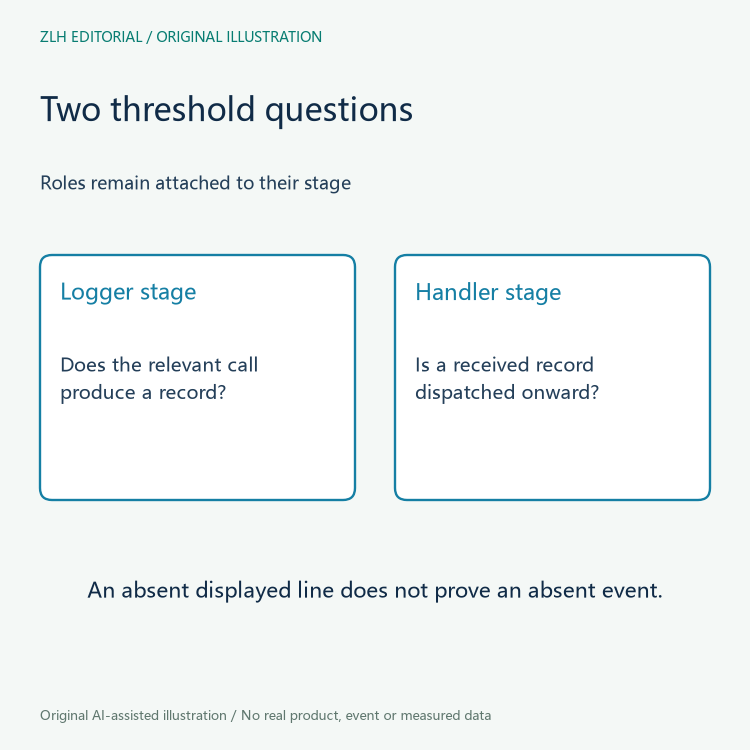
When hierarchy appears in the supplied material, consult the reference for how records are passed to ancestor handlers. Do not invent a rule that every ancestor logger level is reapplied to propagated records. The exact documented route is more useful than an intuitive diagram that silently changes Python’s behavior.
Keep output absence separate from event absence
Imagine that a learner expects a line in a prepared output view. Before interpreting its absence, ask which stage and destination were actually observed. A missing visible line may leave several questions unanswered. It does not establish that the underlying application event never happened.
A maintenance note should preserve that distinction. Describe an observed output condition only when an observation exists, and keep any explanation marked as a question until supported. The present article has no real missing line to diagnose and no equipment state to assess.
Do not change production verbosity merely to make the classroom narrative complete. A later authorized investigation needs its own scope, handling of potentially sensitive records, and knowledge of the application. The reading exercise can end with an accurately described uncertainty.
Review the route in the order a reader can follow
Ask another learner to point to the call, the relevant logger decision, the handler decision, and the intended destination. They should explain each role without turning a planned route into an observed delivery result. If the route is incomplete, identify the missing configuration context.
Then ask what evidence would be needed for a later investigation. The answer should concern the actual arrangement and observation, not a generic demand to collect every available log. A focused question is easier to evaluate and less likely to confuse a display choice with a machine condition.
The final teaching note should retain the distinction between record creation, dispatch, and observation. More examples appear in our maintenance-record practice section and the reading directory. Both original diagrams explain roles only; they contain no executed calls, real log entries, configuration changes, or repair findings.


