

Robot Case Log Maintenance: Preserve the Rollover Context
2026-11-01
Robot Case Log Maintenance: Preserve the Rollover Context
A robot service case includes a log extract that starts in the middle of an exchange. The recipient cannot see how the discussion began and suspects that an earlier event has been removed. A maintenance note should first establish what the extract covers. This fictional documentation case supplies no real service log, private conversation or device event, and it changes no retention setting.
The visible beginning may be an extract boundary
Preserve the file or permitted excerpt received with the case and identify its stated scope. A display beginning at a certain line does not prove that the underlying logging system began recording there. The excerpt may be a selected portion, a current file or another representation. Ask the responsible sender which material was actually included before interpreting the apparent absence.
Imagine that a coordinator receives only the current log attachment, while the support note refers to an earlier exchange. Record that mismatch as a coverage question. Do not fabricate an earlier line to connect the narrative. Equally, do not describe the sender as having deleted evidence without a basis for that conclusion.
The request for clarification should remain within the authorized case scope. A maintainer does not need an entire workstation's logs or unrelated customer records to ask whether the supplied extract covers the relevant exchange. The record can identify the permitted materials and explicitly mark other sources as unavailable or outside scope.
It can also distinguish an attachment supplied directly by the operator from an excerpt forwarded by another coordinator. Each transfer may have its own stated selection. Preserve that explanation where available so that a later reviewer does not mistake a recipient's shortened copy for the logging system's original file boundary.
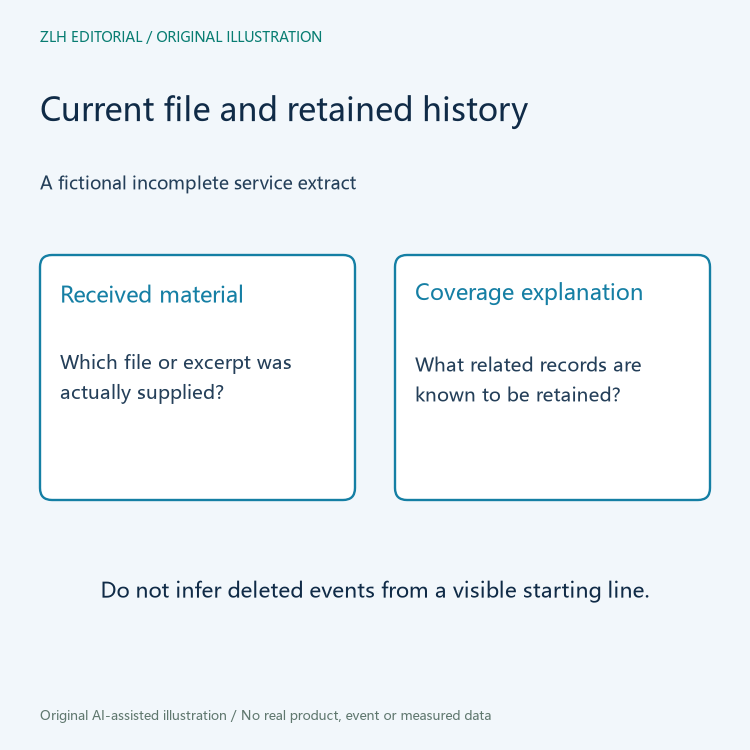
Rollover is a mechanism to ask about, not an assumed cause
The Python logging handlers reference describes rotating file handlers and the handling of rollover files. This provides a concrete example of why a current file and a retained logging history can differ. It does not establish that the supplier uses Python, that rollover occurred in this case or that any earlier file remains available.
The responsible operator can identify the logging arrangement and the files actually retained for the permitted period. Preserve that explanation with the case material. If the arrangement is unknown, keep it unknown. A familiar numbered filename is not enough to reconstruct a retention policy or prove that every expected earlier record exists somewhere.
Nor should a coordinator change retention or trigger a rollover to investigate a documentation gap. Any operational change belongs to an approved maintenance procedure with its own consequences and evidence. The immediate task is to understand the material received, not to make the current logging environment conform to a guessed history.
Record content and exported text are different layers
The Python logging reference distinguishes a LogRecord from the message produced by merging a message with its arguments. This illustrates another boundary relevant to extracts: the displayed text can be a representation of recorded information. It does not reveal the format or fields of an unfamiliar service system.
Ask which export or formatting process produced the supplied text if that information matters to the coverage question. A line missing from one presentation could require a different explanation from a file that was never retained. The record should preserve the actual transformation description rather than treating every text view as a complete, untouched history.
In the fictional handover, the sender may clarify that only a relevant excerpt was supplied, or may provide an additional authorized file. Either response should be linked to the original request. Neither should silently overwrite the first attachment, because the initial recipient's interpretation depended on what was available at that time.

Close only the coverage question that was answered
A later review can state which files or extracts were examined and whether they contain the relevant context. If earlier material is unavailable, retain that limitation. It may constrain what can be concluded about the service case. The absence of retained text should not be converted into an invented account of what the robot or support operator did.
If the response improves the documentation but leaves the original technical incident unresolved, say that plainly. A clearer extract can make follow-up possible without proving a device fault or a completed repair. The maintenance report should identify who owns any remaining technical investigation and what evidence has not yet been obtained.
The original diagrams show file coverage and representation relationships without real logging content. Related material appears in the robot maintenance case section and the article directory. Retaining rollover context gives the next reader a defensible explanation of the supplied evidence while keeping an incomplete extract from becoming a fabricated event history.


